

adwire lab
Responsive ads on Google Ads: Focus on how to make the most of their potential
Learn how Responsive Search Ads (RSAs) combine advertiser creativity with Google's machine learning. This guide covers RSA structure, keyword insertion, pinning, and practical best practices for Google Ads.
What is an RSA?
Google ended the creation of expanded text ads (ETAs) on June 30, 2022, to focus on Responsive Search Ads (RSAs).
ETAs used a fixed structure: three headlines, two descriptions, two display paths, and one display URL. This gave advertisers control over the message, but limited the number of combinations they could test.
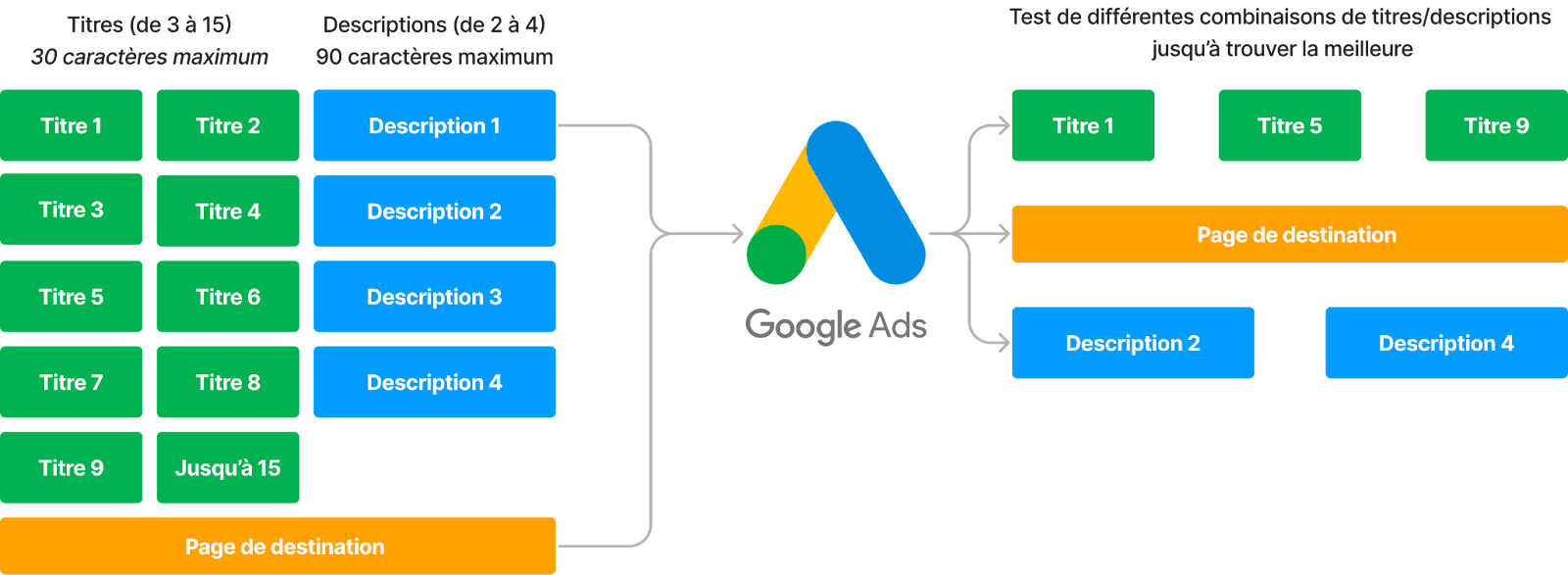
RSAs combine human creativity with machine learning to test different combinations of headlines and descriptions. Advertisers still need to write relevant assets and include the keywords that match the ad group.
The diagram below shows how an RSA is composed:
Pros and cons
The main advantage of an RSA is that it can test multiple headlines and descriptions within a single ad. There is no need to create several ads and wait to compare them manually.
Google tests different combinations over time and shows the combinations that perform best more often. This gives advertisers more room to test messages while keeping the campaign structure manageable.
Some benchmarks report a 5–15% higher click-through rate for RSAs than for expanded text ads. This figure should be treated with caution: averages do not apply equally to every advertiser, and more clicks do not automatically mean more business results.
Depending on the account and the campaign, an RSA can also generate a higher conversion rate or cost per conversion than an existing text ad. The right comparison should therefore include conversions, cost, and business objectives, not only click-through rate.
How to set up an RSA
An RSA requires at least three headlines and two descriptions. That is the minimum configuration, not necessarily the best one.
If historical data is available, use the messages from your best-performing ads as a starting point. Without historical data, use the following principles to create a balanced set of assets.
1. Give each headline and description a distinct role
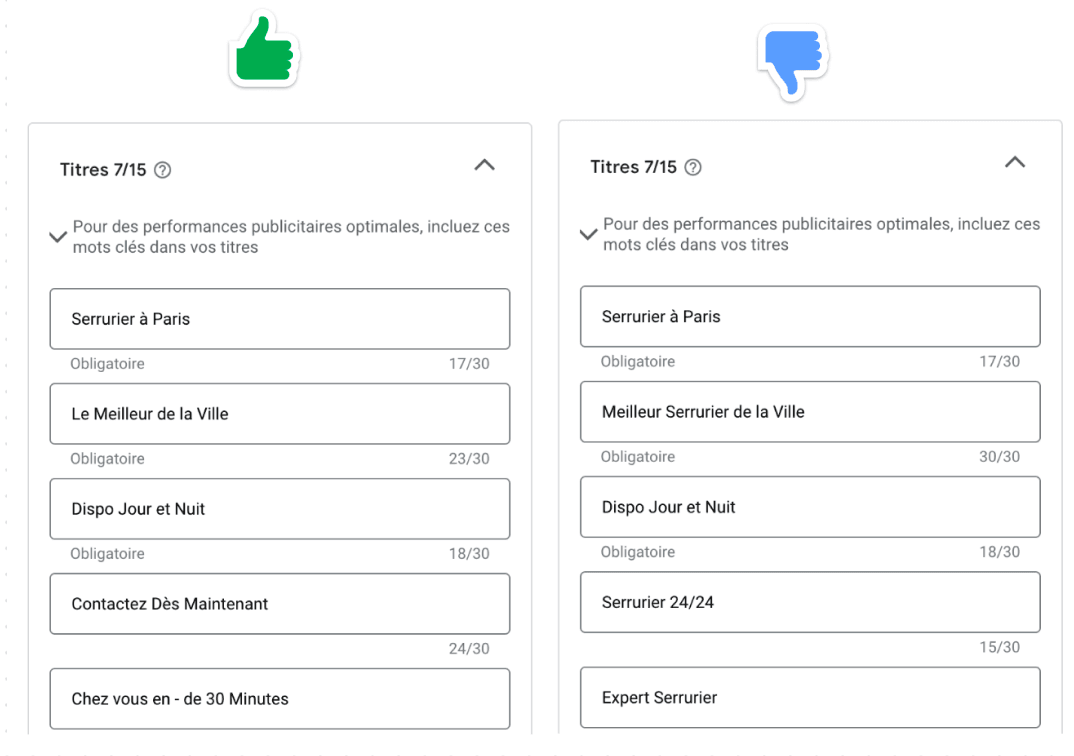
Avoid repeating the same message in every headline. A good RSA offers several ideas that can be combined without losing meaning.
For example, one headline can reflect the search intent, while others highlight the service, benefit, availability, or competitive advantage. The example below contrasts that approach with an ad that repeats the keyword without adding new value.
2. Vary the length of your headlines and descriptions
It is useful to write headlines and descriptions that make good use of the available character limits. However, not every headline needs to reach the maximum length.
Include shorter headlines as well. This gives Google more flexibility when assembling the ad and can increase the chance of showing a third headline during an auction.
3. Use pinning selectively
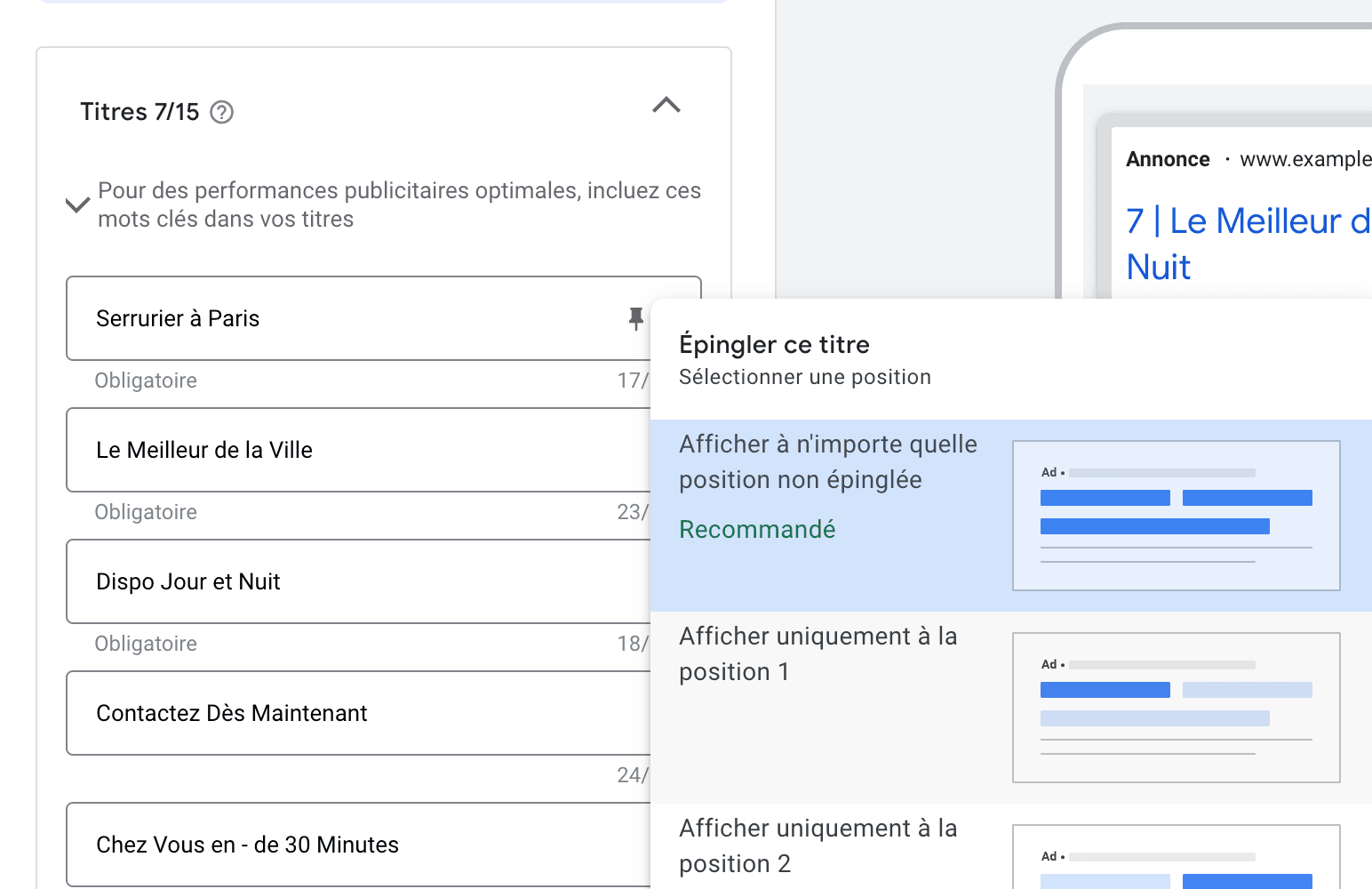
Google can test headlines in different positions and do the same with descriptions. This helps identify effective combinations for different users, keywords, and devices.
If a message must always appear, such as a brand name or a legal disclaimer, you can pin it to a specific position. Use this option only when the message really needs a fixed position.
4. Pin only when it serves a clear purpose
Pinning can be useful, but it reduces the number of combinations available to the system. That restriction can affect performance.
Test the difference when possible by comparing similar ads with and without a pinned headline. Google also assigns an ad strength score while you create an RSA:
- Incomplete
- Poor
- Average
- Good
- Excellent
Aim for a strong ad, but do not treat the score as a performance guarantee. An “Excellent” rating does not automatically mean a better click-through rate or conversion rate.
5. Use keyword insertion carefully
Keyword insertion can dynamically adapt part of an ad to the query that triggered it. Used carefully, it can improve relevance for the user.
How does keyword insertion work?
- Dynamic personalization: the insertion is replaced by the keyword that triggered the ad.
- Default text: if the keyword is too long or unsuitable, Google uses the default text defined in the insertion.
Potential benefits include greater relevance, a possible improvement in ad quality, and less need to create a separate ad for every keyword. Always check that the resulting sentence remains natural and accurate.
6. Review the performance combinations report
Google provides a performance combinations report. It shows how many impressions each combination of assets has received and which combination has been shown most often.
Impressions alone do not prove that a combination performs best. Use the report as a starting point, then compare clicks, conversions, and cost against your campaign objectives.
Best practices still need good marketing
Technical settings matter, but the core of an effective ad remains the message. It should be relevant to the audience, easy to understand, and connected to a clear business objective.
Two useful frameworks for writing persuasive messages are the AIDA model and Cialdini’s seven principles of persuasion.
The AIDA model
The AIDA model structures a marketing message around four steps:
- Attention: capture the audience’s attention with a strong headline or value proposition.
- Interest: provide relevant information that addresses the user’s needs.
- Desire: highlight benefits, advantages, testimonials, or case studies.
- Action: use a clear call to action, such as “Buy now,” “Contact us,” or “Try for free.”
Cialdini’s seven principles of persuasion
Robert Cialdini’s principles can help make an advertising message more persuasive:
- Reciprocity: offer something useful, such as a guide or consultation.
- Commitment and consistency: encourage small initial commitments that can lead to larger actions.
- Social proof: show that other customers trust the product or service.
- Authority: highlight expertise, certifications, or awards.
- Liking: create an emotional connection with the audience.
- Scarcity: use genuine urgency or limited availability when relevant.
- Unity: emphasize shared values or a common identity.
These frameworks can help structure messages that attract attention, build interest, and encourage action. They should support campaign data and testing, not replace them.
Conclusion
Responsive Search Ads give advertisers more room to test messages while Google automates the combination of assets. Start with distinct headlines and descriptions, use pinning and keyword insertion carefully, and evaluate combinations against conversions and cost—not clicks alone.
Further options, such as location insertion and countdowns, can be explored separately.